A fear swept through the world in the late fifties: projections from the United States Census Bureau announced that, around 1960, humanity would reach 3 billion inhabitants. For Paul Ehrlich, a young Stanford biologist, that number was the sound of an explosion in slow motion. A specialist in lepidoptera (butterflies), Ehrlich had spent years observing how certain insect populations multiplied until they devoured their environment and collapsed in a mass death. If that happened time and again in fragile ecosystems, why would it be any different for humans?
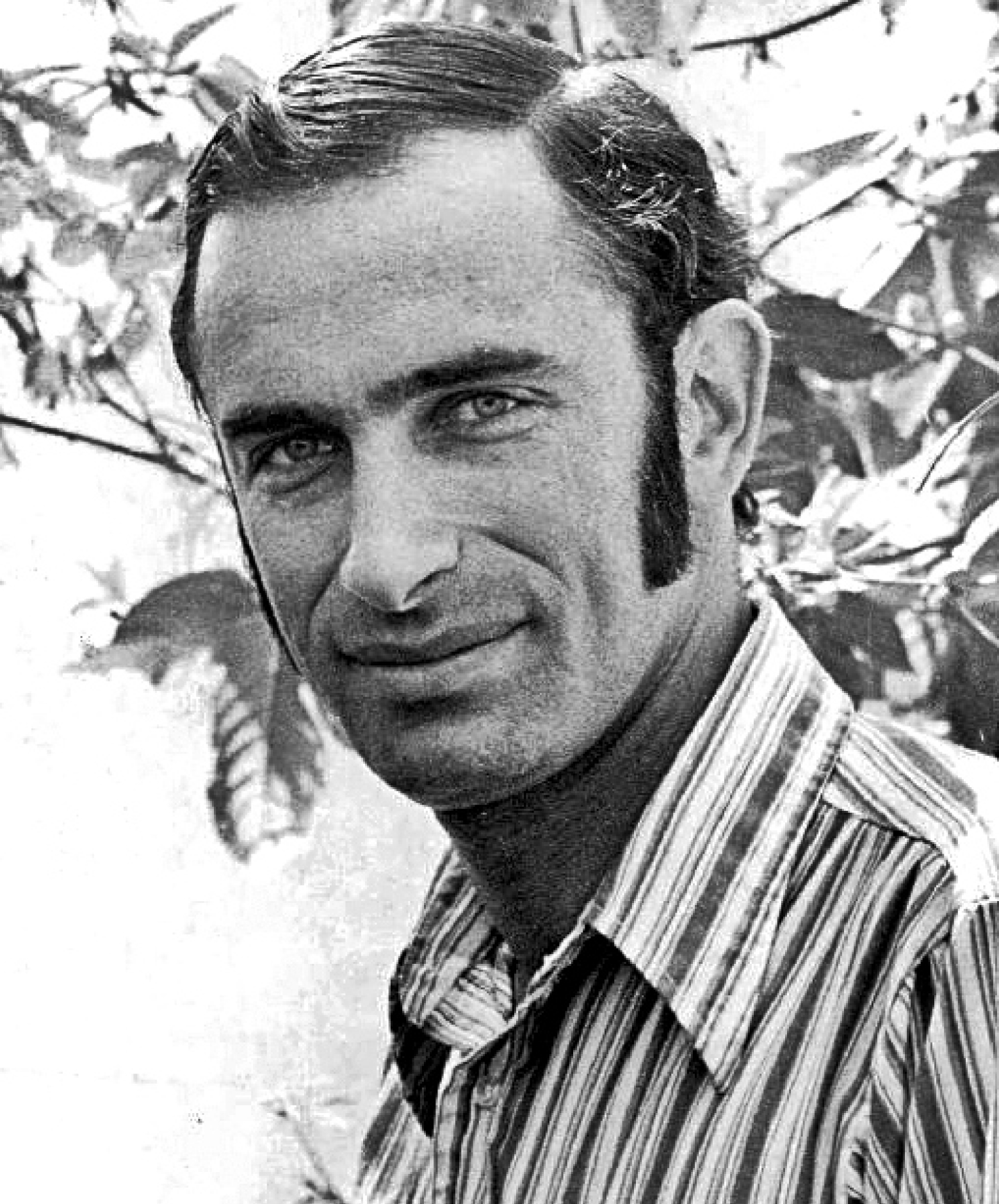
Paul Ehrlich
This fear, shared across the planet, did not arise in a vacuum, but from recent scars. There was the fresh memory of the Bengal famine of 1943, where demographic pressure and disastrous political decisions turned food into a mortally scarce commodity. While Ehrlich matured his theories, China suffered the “Great Leap Forward”, a catastrophe that left tens of millions dead. The shared narrative was simple: if with 3 billion the planet was already a cemetery of empty stomachs, a world with twice as many people would be hell on earth.
The Era of Predictions
By 1968, panic became dogma. Ehrlich published The Population Bomb, declaring that the battle to feed all of humanity was over and that hundreds of millions would die in the 70s. In 1972, the Club of Rome raised the stakes with Limits to Growth. Using the most advanced computers, they predicted the end of civilization between 2040 and 2050 if industrial and population growth were not stopped immediately.
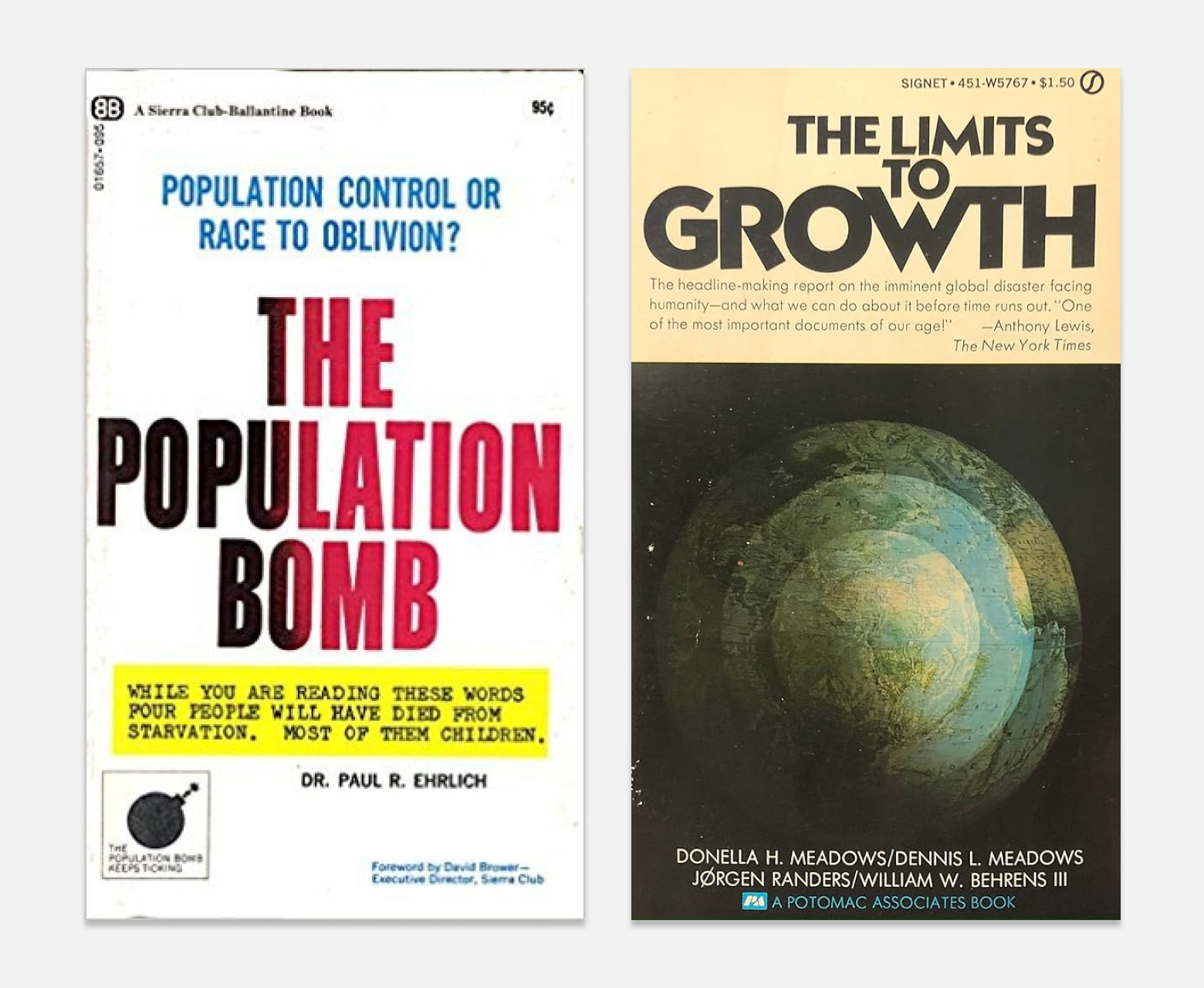
The Population Bomb & Limits to Growth
These visions filtered into the halls of power. If the future was a sinking ship, leadership felt a moral obligation to throw someone overboard. This climate set the stage for China to implement the one-child policy in 1979: a violent decision born from the conviction that the world was running out of space.
Humanity shared a common narrative, it painted a terrifying future, and responsible politicians made responsible decisions to fight against the demographic Armageddon.
The Tunnel and the Cone
How did so many brilliant minds fail? Ehrlich and the Club of Rome locked themselves into a Projected Future: a deterministic exercise based on linear extrapolation. They assumed that the future is simply an augmented version of the present.
However, in Strategic Complex Design (SCD), we understand that the future is not a tunnel, but a Cone of Uncertainty. As we move away from the present, the range of possibilities widens. Within this cone inhabits the Probable (linear statistics), but also the Possible (science fiction until it happens) and the Preferable.
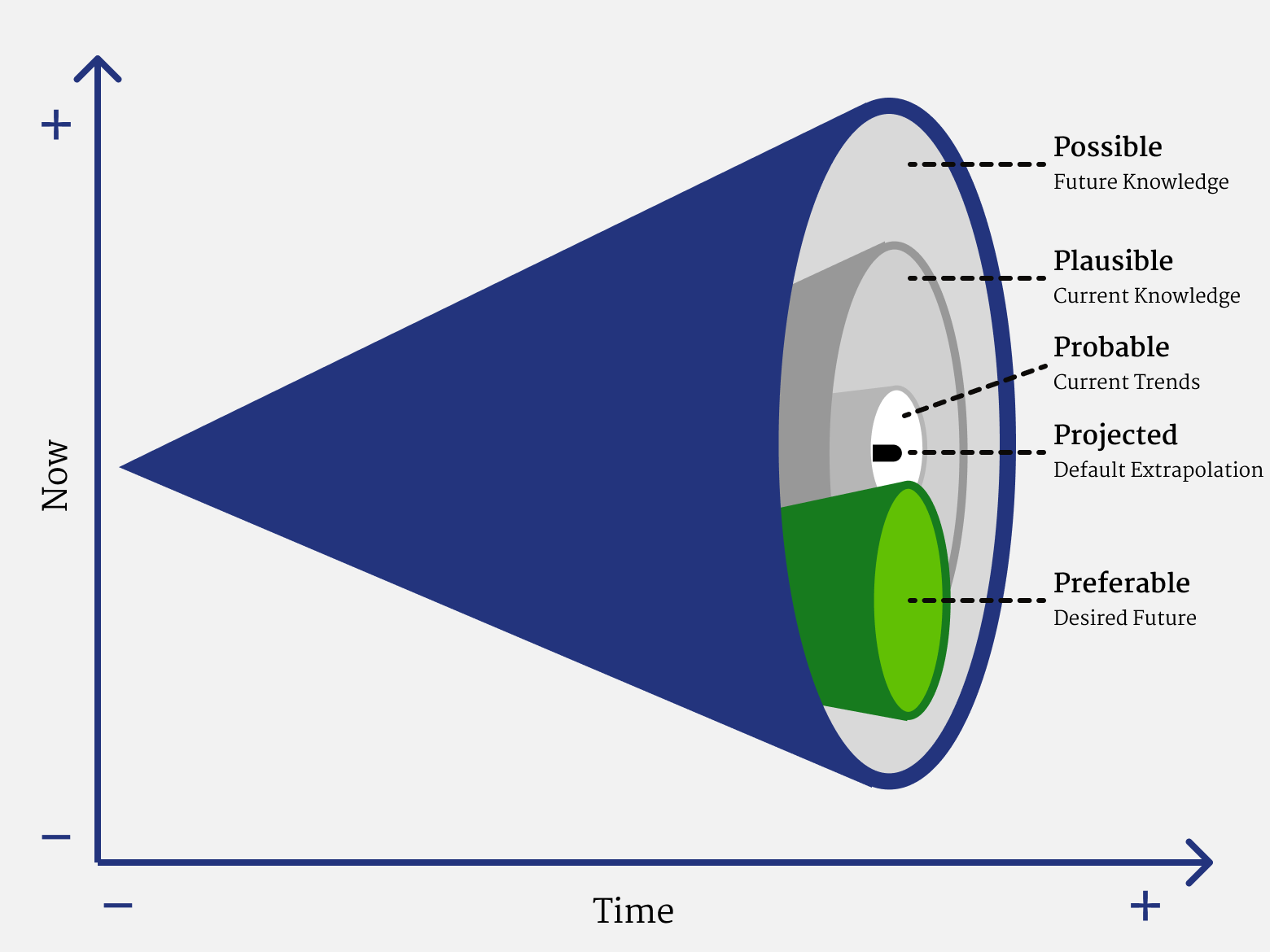
Cone of uncertainty
In 1959, the world ignored that the cone was expanding. In the midst of the noise of panic, there were Weak Signals: early and almost imperceptible indicators of a paradigm shift. To detect them, one must know how to distinguish the signal from the noise, something impossible when the noise is a cry of apocalypse.
Two Black Swans
While experts fed computers with data about the end of the world, Norman Borlaug was kneeling in the mud of an experimental field in Mexico. Borlaug, an obsessive agronomist, decided to change the architecture of the plant itself. By developing high-yield wheat varieties, he introduced the first Black Swan: the Green Revolution. Food production jumped from a predictable line to an exponential curve of efficiency. Borlaug proved that technology is a catalyst that breaks linear projections, saving a billion people.

Norman Borlaug, the man who tried to feed the world with wheat
If Borlaug was the Black Swan of supply, the second one attacked demand from the medicine cabinet. In 1945, Kingsley Davis was already talking about the Demographic Transition: the idea that with greater wealth and education, fertility decreases. But a catalyst was missing: the birth control pill (1960). This small tablet separated sex from reproduction, allowing Davis’s vision to become a reality.
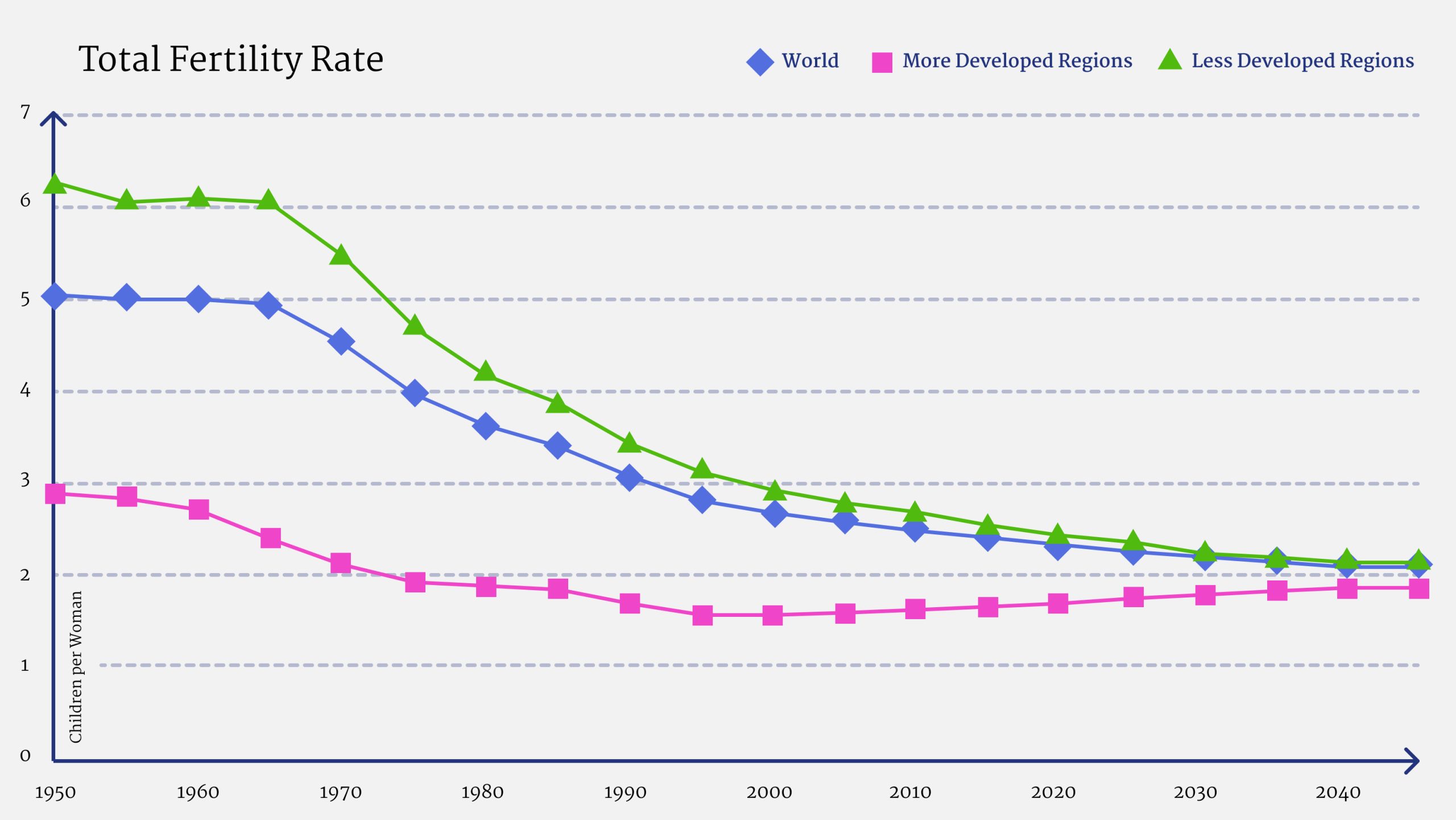
World total fertility rate. United Nations. World Population Prospects.
In the 70s, without decrees or police, the population in half the world began to have fewer children voluntarily. Women, with access to education and autonomy over their bodies, decided that the preferable future was not the large family of the agricultural era. Prosperity turned out to be the best demographic regulator in the world. The future was not a tunnel toward overpopulation, but a process of natural balancing that no one, in their eagerness to predict, stopped to observe.
The Stories We Tell Ourselves
In strategic design, our true raw material is not data, but anticipation. Our minds automatically project a future before any challenge. Therefore, the power of Strategic Complex Design (SCD) is not to predict, but to manage the narratives we build today.
The future is not predicted; it is inhabited first through the stories we tell ourselves. Assuming the role of builders of the future requires three critical movements:
- Making biases explicit: What fears are dictating this solution?
- Mapping second-order consequences: What new vulnerabilities are we creating if this narrative succeeds?
- Designing for Preferability: Let’s not look for what is “probable” based on yesterday, but for what is “preferable” based on our values today.
It has never been so critical to understand this dynamic as at this precise moment. Today, it is not demographers or biologists who dominate the narrative of tomorrow, but the architects of Artificial Intelligence. And history is repeating itself with haunting precision.
Last week, a post by Matt Shumer titled “Something big is happening” spread through the networks like wildfire, reaching more than 82 million people in a few days. Its message was pure narrative fuel: urgency, total disruption, an imminent paradigm shift that would transform everything. It is, in essence, the 2026 version of the “Population Bomb.” It is a story that pushes us into a Projected Future where technology is an inevitable force to which we can only react.

Matt Shumer: Something big is happening
However, voices like Gary Marcus and his response: “About that Matt Shumer post that has nearly 50 million views – Something big is allegedly happening” question that script. They remind us that if we buy the narrative of “inevitability” without questioning its biases, we are surrendering control. If we accept that the future of AI is a straight line toward absolute efficiency or total disruption, we are ignoring the Black Swans that our own ethics and design can generate.
We are at a turning point where the stories we choose to validate will build the world we will inhabit. AI can be the tool that manages systemic variety to create unprecedented prosperity, or it can be the algorithm that encodes our deepest anxieties. The difference is not in the code, but in the story that precedes it.
As the poet Muriel Rukeyser said:
“The universe is made of stories, not of atoms.”